
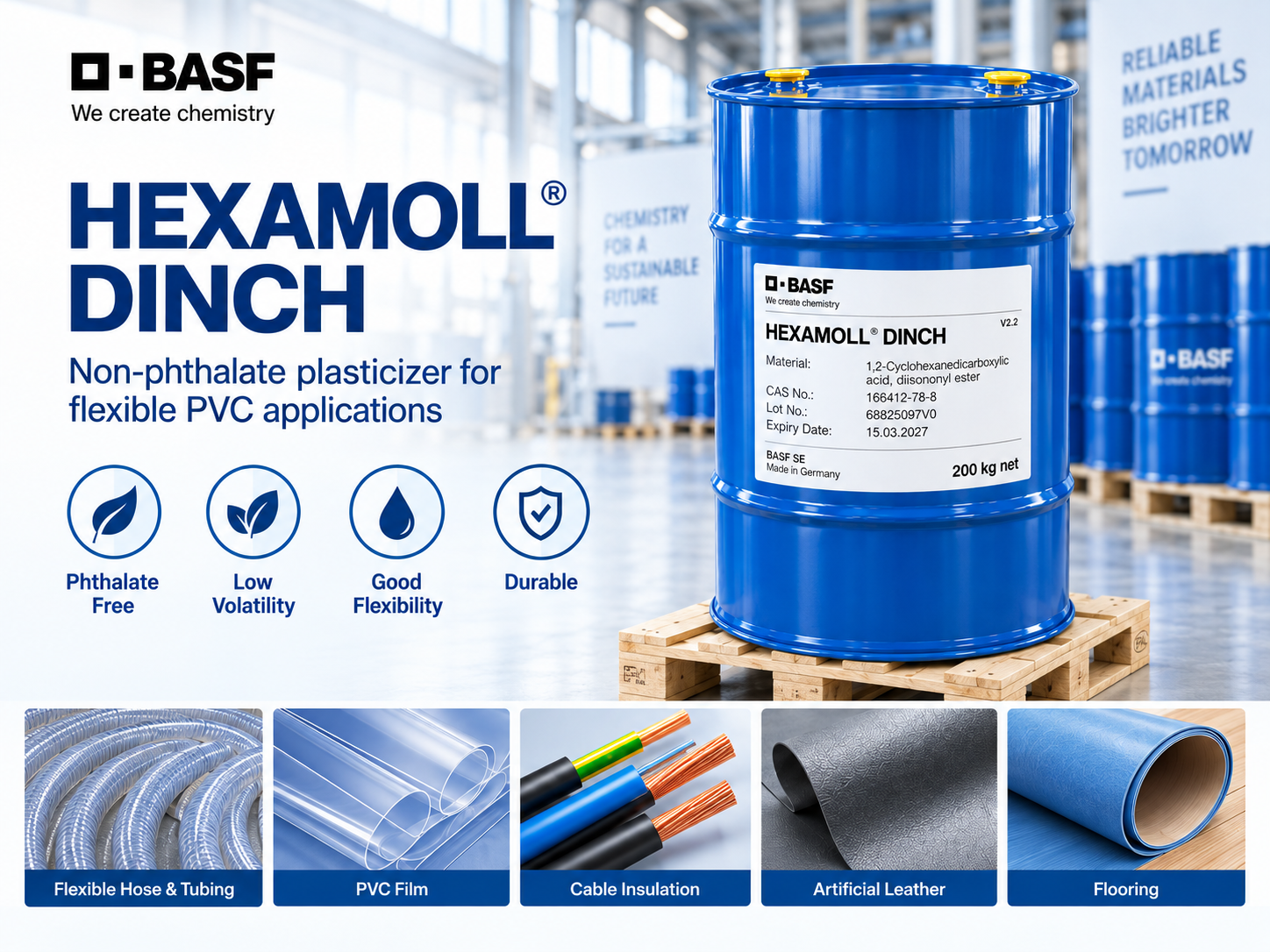
HEXAMOLL® DINCH is a non-phthalate plasticizer from BASF developed for flexible PVC applications requiring good flexibility, durability and low volatility. It can be considered for a wide range of applications including flexible hose and tubing, PVC film, cable insulation, artificial leather and vinyl flooring. When replacing DOP/DEHP, manufacturers should re-evaluate hardness, viscosity, gel/fusion behavior, compatibility and any migration or regulatory requirements applicable to the finished product.
Why consider replacing DOP/DEHP?
Traditional phthalates such as DEHP/DOP are subject to significant controls in major markets, particularly for toys, childcare products, medical devices and other close-contact applications. Moving to a non-phthalate plasticizer can therefore be part of a broader formulation redesign and compliance-risk strategy.
What is Hexamoll® DINCH?
Hexamoll® DINCH is BASF’s registered name for 1,2-cyclohexane dicarboxylic acid, di-isononyl ester. It is a non-phthalate plasticizer used in PVC and other polar polymers, particularly where manufacturers need an alternative to traditional orthophthalates.
Main applications
- Flexible hose & tubing: flexible-PVC formulations requiring good flexibility and stability.
- PVC film & sheet: applications requiring consistent processing and flexibility.
- Cable insulation: flexible PVC insulation and jacketing.
- Artificial leather: coated flexible-PVC materials and upholstery surfaces.
- Vinyl flooring: flexible and semi-rigid PVC flooring systems.
- Sensitive applications: toys, childcare, medical and food-contact uses must be assessed against finished-product regulatory requirements.
Reference technical data
| Property | Reference value |
|---|---|
| Chemical name | 1,2-Cyclohexane dicarboxylic acid, di-isononyl ester |
| CAS No. | 166412-78-8 (outside USA); 474919-59-0 (USA) |
| Molecular formula | C26H48O4 |
| Molecular weight | 424.7 |
| Appearance | Clear, colorless liquid |
| Density at 25°C | Approx. 0.945 g/cm³ |
| Dynamic viscosity at 20°C | Approx. 52 cP |
| Ester content | ≥ 99.5 wt% |
| Phthalate content | ≤ 0.01% |
Values above are reference data based on BASF technical information. Current TDS and batch CoA should be used for material approval.
Replacing DOP/DEHP in a formulation
DINCH can be used in PVC and other polar polymers. A universal 1:1 replacement should not be assumed for every formulation. Manufacturers should validate hardness, plastisol viscosity, gel/fusion behavior, compatibility, low-temperature flexibility, volatility and migration performance in the finished formulation.
Compliance considerations
- Toys: check current phthalate restrictions and toy-safety requirements for the destination market.
- Food contact: review applicable conditions of use and migration limits.
- Medical devices: suitability must be established at finished-device and regulatory-dossier level.
- Material documentation: current TDS, SDS, CoA and manufacturer compliance declarations should be reviewed before commercial production.
GKTECH support
GKTECH can discuss DOP/DEHP conversion targets, provide manufacturer technical documentation and coordinate sample evaluation where appropriate for the actual application.
- Discuss formulation and DOP/DEHP replacement targets.
- Support with TDS/SDS and technical data.
- Coordinate sample evaluation and application trials where appropriate.
Technical references
Gia Khang Technology Co., Ltd.
Website: gktech.vn · Email: gktech@gktech.vn · Hotline: +84 36 262 1886