
Test background
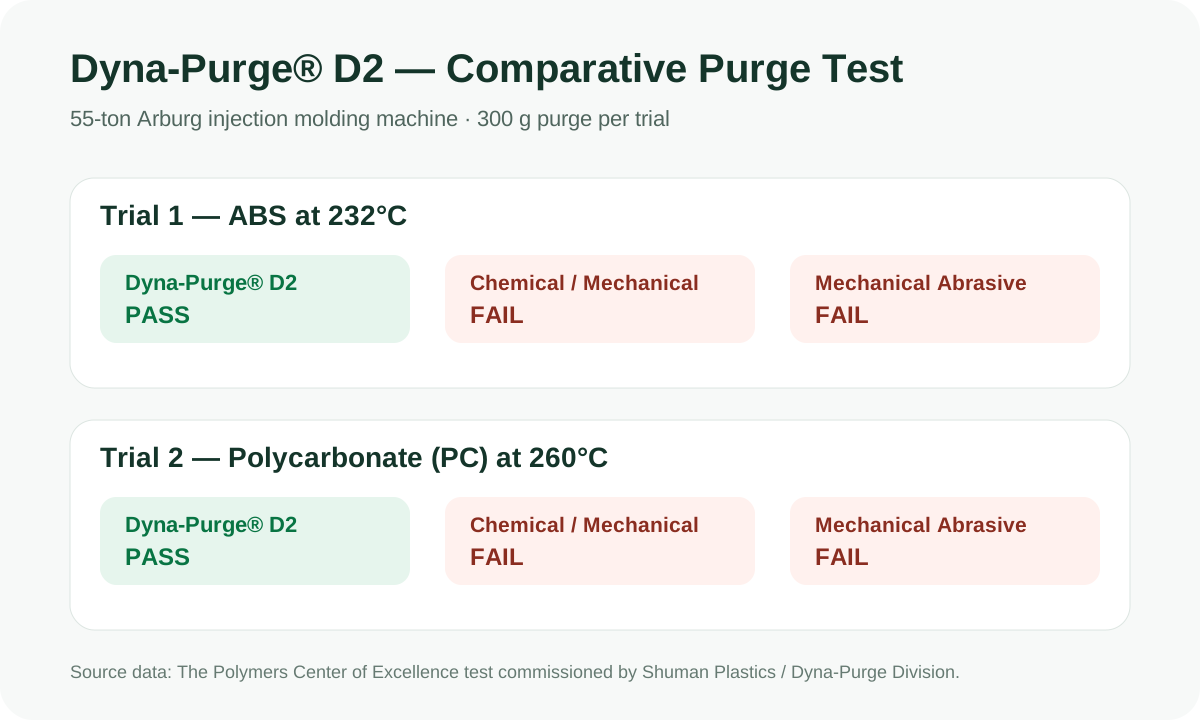
The test was conducted by The Polymers Center of Excellence in Charlotte, North Carolina and commissioned by Shuman Plastics, Inc. – Dyna-Purge Division. The objective was to compare three commercial purging technologies under the same test procedure and evaluate residual color or contamination after purging.
The products compared were Dyna-Purge® D2, a Chemical/Mechanical purging compound and a Mechanical Abrasive purging compound. The two processing resins were ABS at 232°C and polycarbonate (PC) at 260°C.
Test conditions and procedure
Machine & resins
55-ton Arburg injection molding machine. ABS was processed at 450°F (232°C), while polycarbonate was processed at 500°F (260°C).
Purge quantity
Each test used 300 g of purging compound. After purging, 100 g of natural resin was introduced to evaluate whether black resin or contamination remained.
The common procedure included cleaning the hopper, introducing black resin, purging with 300 g of the test compound, then transitioning to natural resin. Post-purge material was visually evaluated as Pass or Fail based on the presence of contamination.
Trial 1 — ABS
| Purging compound | Result | Observation after 300 g purge |
|---|---|---|
| Dyna-Purge® D2 | PASS | Both purge compound and post-purge resin were clean and free of contamination. |
| Chemical / Mechanical | FAIL | Traces of black ABS remained. |
| Mechanical Abrasive | FAIL | Traces of black ABS remained. |
Trial 2 — Polycarbonate (PC)
| Purging compound | Result | Observation after 300 g purge |
|---|---|---|
| Dyna-Purge® D2 | PASS | Both purge compound and post-purge resin were clean and free of contamination. |
| Chemical / Mechanical | FAIL | Traces of black PC remained. |
| Mechanical Abrasive | FAIL | Traces of black PC remained. |
Why can D2 clean effectively?
The test document describes Dyna-Purge® D2 as a mechanical, non-abrasive purging technology. Its proprietary components are designed to create shear and viscous flow toward boundary layers, help the purge reach stagnation points and target degraded material adhering to process surfaces.
The Chemical/Mechanical alternative may require temperature adjustments and, in some cases, a soaking phase. The Mechanical Abrasive alternative uses mineral-filled material to create abrasive cleaning action; the test document also notes that abrasive purging compounds may cause equipment wear.
Practical plant applications
- Color changes: especially dark-to-light or dark-to-natural transitions.
- Resin changes: reducing residual polymer in screw, barrel and nozzle areas.
- Black specks / degraded polymer: helping remove deposits from lower-flow or stagnation areas.
- Preventive maintenance: scheduled purging before deposits become severe enough to require manual teardown.
- Injection molding, extrusion, compounding and blow molding: these application groups are listed in the test document for D2.
D2 processing information listed in the test document
| Temperature range listed in the document | 149–316°C (300–600°F) |
| Minimum clearance | 0.65 mm (0.025 inch) |
| Approximate amount | About 1–2 times barrel capacity |
| Applications | Injection molding, extrusion, compounding and blow molding |
Evaluate total changeover cost, not only price per kg
For a color change or machine-cleaning event, the useful comparison is total cost: purge quantity, resin flushed to displace the purge, machine downtime, rejected shots after the transition and labor time. A higher price per kg can still be economical if it materially reduces transition time and scrap.
Explore the product range
See Dyna-Purge grades and selection guidance by temperature, polymer and process.
Explore Dyna-Purge →Explore the technology
Read more about purging mechanisms, black-speck troubleshooting, color change and resin change.
Purging technology →Want to test Dyna-Purge D2 on your machine?
Send your resin, color, processing temperature, barrel capacity and current problem. GKTECH can recommend a trial quantity and operating approach.